

A crossbody bag with chain strap should sit close to your body, with the bag around your waist or upper hip, where you can reach the opening without lifting your shoulder. Treat that position as a starting point, then adjust for your torso, outerwear, and the loaded bag: the chain should lie untwisted, and the bag should not knock against your thigh as you walk.
- A crossbody bag with chain strap should sit near your waist or upper hip without restricting movement.
- Glamortrends favors practical handbag styling: choose placement around your outfit, not a fixed strap measurement.
- Check chain-strap fit with your usual essentials inside and your actual jacket or hoodie on.
- A fixed chain needs an on-body fit check; do not assume you can shorten it safely.
How should a crossbody bag with a chain strap sit?
Start at your upper hip. Adjust for comfort, access, and the silhouette you want. There is no single strap length that puts every bag in the same place on every person.
Use these checks for your 2026 handbag shopping rather than choosing by a model photo alone. If you are also comparing shorter carrying styles, the guide to mini shoulder bags for evenings out covers a different wearing position.
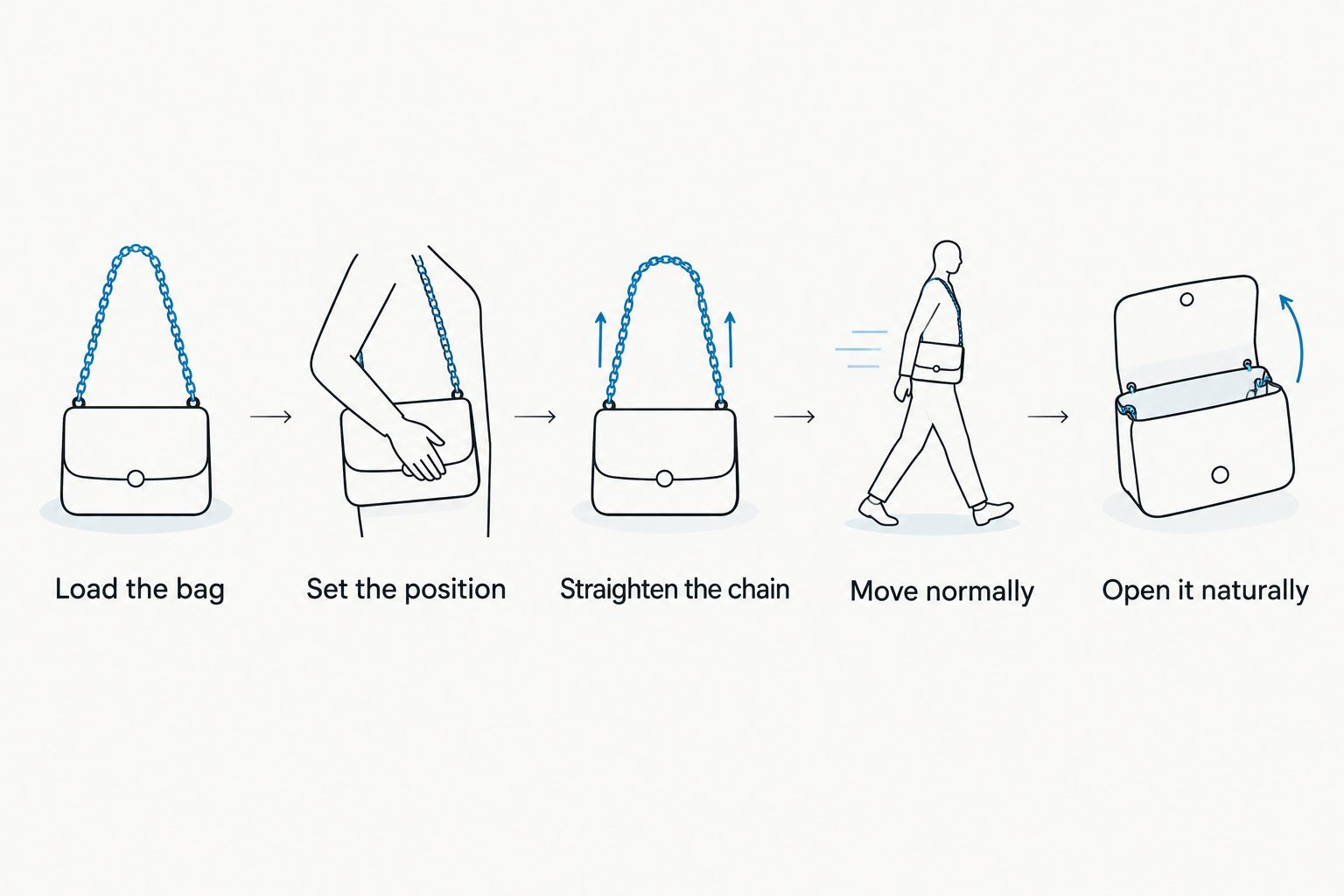
- Load the bag. Put in the essentials you actually carry. Check the fit with those items inside, not with an empty bag.
- Set the position. Place the bag around your waist or upper hip, slightly toward the front or directly at your side.
- Straighten the chain. Follow it from attachment to attachment. Remove twists and check that any shoulder panel lies flat.
- Move normally. Walk, turn, sit down, and reach forward. Notice whether you keep catching or repositioning the bag.
- Open it naturally. Reach the closure without shrugging your shoulder or pulling the entire bag upward.
A mirror checks the look. Movement checks whether that look works. Keep the position that passes both tests.
Why this matters
A bag can look right while standing still and feel wrong once you leave the mirror. A chain that presses into your shoulder, a closure trapped beneath your arm, or a bag that swings into your leg needs attention before styling details do.
For your 2026 outfits, make the fit test part of getting dressed. Try the bag over the layer you plan to wear, then look at where its edges meet your jacket hem, waistband, and pockets. You want a deliberate placement, not a bag you keep moving out of the way.
Upper hip: best for an everyday starting position
Upper-hip placement is the best starting point for everyday wear. Set the bag close enough to reach without stretching, with the chain running diagonally across your torso rather than twisting around itself.
This position gives you a clear reference when comparing different bags. If a bag feels awkward here, test a slightly higher or more forward position before deciding the design does not work for you.
The trade-off is contact with your outfit. A bag at your side can cover a pocket or sit directly over a bulky jacket hem. Move it slightly forward and check whether you can still put your hand in the pocket comfortably.
Waist level: best for a higher, closer silhouette
Waist-level placement is best when you want the bag higher on your torso. Try it with a small bag and a simple outfit so you can see whether the higher position looks intentional.
The benefit is keeping the bag away from your thigh. The drawback is crowding: the bag can sit beneath your elbow, overlap a belt, or interrupt the front of a jacket. Sit down before committing to this position.
Do not force a fixed chain into a shorter configuration just to recreate a photo. Use only carrying arrangements supported by the bag's construction and instructions.
Lower hip: best for testing a longer, relaxed line
Lower-hip placement is a styling option, not a fit requirement. Try it if you prefer a longer diagonal line across your outfit, but check the bag's movement carefully.
A lower position leaves more space beneath your arm. Its drawback is where the bag meets your stride: if you keep holding it still while walking, move it higher or choose a different strap configuration.
Do not judge the position by torso length alone. The bag's height matters too. A taller bag can extend farther down your leg even when its top edge sits in a familiar place.
| Wearing position | Best for | What works | What to check |
|---|---|---|---|
| Upper hip | An everyday starting point | Reachable placement beside or slightly in front of you | Pocket access and jacket-hem overlap |
| Waist level | A higher, closer silhouette | Keeps the bag away from your thigh | Elbow space and seated comfort |
| Lower hip | A longer outfit line | Leaves room beneath your arm | Swinging or contact with your stride |
Why crossbody bag placement varies
The right position changes with the bag and the clothes underneath it. Use these factors to diagnose the fit instead of searching for a universal measurement.
- Torso length: The same strap does not place a bag at the same body landmark on everyone.
- Bag height: Compare where the top and bottom sit, not just where the chain attaches.
- Outerwear: A hoodie or jacket changes the surface the strap crosses. Repeat the fit check over that layer.
- Contents: Judge comfort with your normal essentials inside. Remove unnecessary items if the loaded bag feels uncomfortable.
- Strap construction: A fixed chain, an adjustable section, and a shoulder panel require different checks. Confirm which features the actual bag has.
- Carrying position: Moving the bag from your side toward the front changes access and how it meets your arm.
For 2026 shopping, save the measurements of a bag that already works for you. Use them as a comparison reference, not as a promise that another design will fit identically.
How to check strap length before buying
Compare like with like. Full strap length and strap drop are different measurements. Read how the seller defines the measurement before comparing it with a bag you own.
Lay your current bag flat and note where you measure from and to. If you compare full strap lengths, use the same attachment points. If the listing gives a drop measurement, check its diagram or explanation rather than treating that figure as the full chain length.
Then separate appearance from confirmed features. A visible chain does not establish that it is adjustable, removable, or suitable for doubling. Look for those details in the product information.
Use this buying checklist:
- Confirm whether the chain has an adjustment mechanism.
- Check how the chain connects to the bag.
- Find the bag's dimensions as well as its strap measurement.
- Look for a shoulder panel if that feature matters to you.
- Check the closure position and how you would reach it.
- Ask for clarification when the measurement description is unclear.
A model image shows styling, not your fit. Buy from clear measurements and confirmed construction details, not an assumed wearing height.
How to wear a chain-strap crossbody with a hoodie or jacket
Start with the outer layer, then place the bag. That order lets you see whether the chain traps fabric or pulls the front of the outfit into a shape you do not want.
With an oversized hoodie
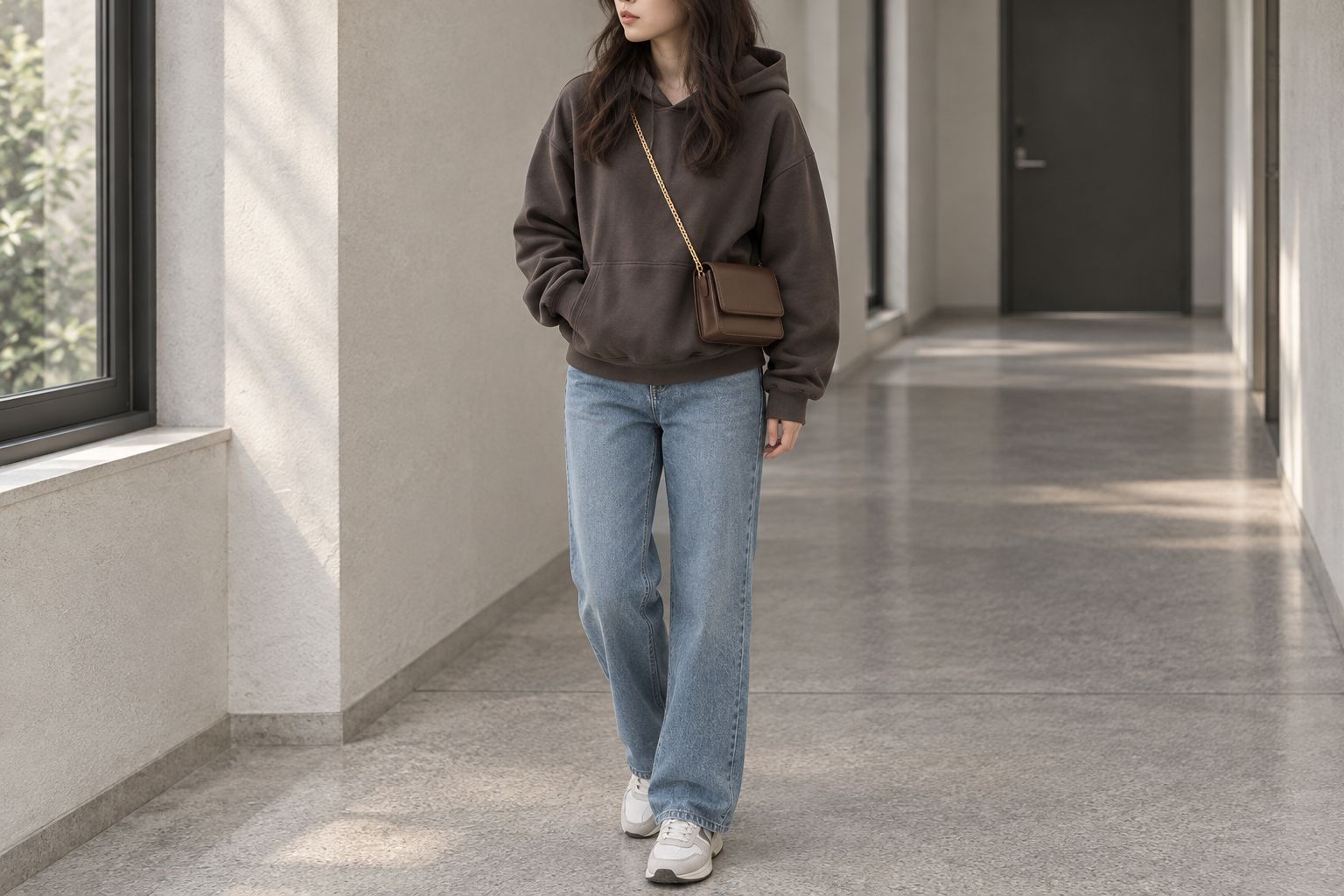
Keep the chain clear of bunched fabric. Put the hoodie on, settle the hood and sleeves, then add the bag. Smooth the fabric beneath the diagonal strap without pulling the entire hoodie tight.
Try the bag slightly forward at upper-hip level with straight-leg jeans and sneakers. That gives the bag a distinct place in the outfit while leaving the hood visible. If the hem gathers beneath the bag, adjust its position rather than repeatedly tugging the hoodie down.
The trade-off is compression: a crossbody strap crosses a loose silhouette. If preserving the full drape matters most, test another supported carrying style instead.
With a cropped jacket
Try a plain tee, high-rise jeans, and a cropped jacket, then place the bag beside the upper hip. Look at the space between the jacket hem and bag rather than assuming they must line up.
If the bag sits directly over a zipper or bulky pocket, move it forward. The goal is a clear silhouette without hardware pressing against hardware as you move.
With a longer coat
Try the bag over the coat you will actually wear. Check it with the coat open and closed; choose the arrangement you intend to use outside.
For a simple 2026 outfit, combine a long coat, straight trousers, and ankle boots, then let the chain be the visible metal detail. Keep the bag forward enough to reach, but not where it prevents you from closing the coat comfortably.
How do you style the chain without overdoing the outfit?
Choose which detail leads. If the bag's chain is the statement, start with a plain neckline and restrained jewelry. Add more only if you like the combined effect.
Matching every metal is a styling choice, not a fit rule. Look at the chain beside your earrings, belt buckle, and jacket hardware. Keep the combination you enjoy rather than replacing pieces just because the finishes differ.
Glamortrends handbag styling is best for shoppers building standout everyday outfits around clothes they already own. Use that approach here: test the chain bag with a familiar outfit before buying extra accessories to make it work.
Should a crossbody bag sit in front or at your side?
Start slightly in front of your hip for access, then test the side position. Your elbow should move freely, and you should reach the closure without twisting awkwardly.
Neither position wins automatically. Choose the one that works while walking and sitting, not just the one that looks strongest in a mirror.
Can you shorten a chain strap by doubling it?
Double a chain only when the bag is designed for that configuration. Check the product instructions or confirmed construction details before threading a chain through attachments in a new way.
Do not knot links, bend connectors, or improvise a shortening method around a closure. If the fixed length fails your fit check, choose a different strap arrangement or bag.
FAQ
Where should a crossbody bag with chain strap sit?
A crossbody bag with chain strap should start around your waist or upper hip, close to your body. Adjust until you can walk, sit, and reach the opening without shoulder pressure or the bag hitting your thigh.
Is my crossbody bag too low if it reaches my thigh?
A bag that repeatedly hits your thigh while walking sits too low for that wearing setup. Try a higher position if the strap allows it, then repeat the movement check.
Should a chain strap lie flat across my chest?
A chain strap should lie untwisted along its intended path across your torso. Check that links, connectors, and any shoulder panel are not folded or pressing uncomfortably.
Can I wear a chain crossbody over an oversized hoodie?
You can wear a chain crossbody over an oversized hoodie if the loaded bag feels comfortable and the strap does not trap awkward folds. Settle the hoodie first, then check the bag while walking and sitting.
Does every chain crossbody have an adjustable strap?
Not every chain crossbody has an adjustable strap. Confirm the mechanism and measurement in the product information instead of assuming a visible chain can be shortened.
What should I do if the chain hurts my shoulder?
Stop wearing the bag in the setup that hurts your shoulder. Reduce unnecessary contents and check for twists; if discomfort continues, choose a different strap or bag rather than forcing the fit.
Should I buy a chain bag based on the model photo?
Do not choose strap fit from a model photo alone. Compare the stated bag and strap measurements with a bag you already wear, and confirm whether the strap is fixed or adjustable.
One last thing
Judge the bag from the side, too. A front view can hide a bag that tilts outward, catches your elbow, or lands against the back of your thigh. Check the side view after loading it, then walk before making the final call.
For your next 2026 handbag decision, use the Glamortrends approach: choose the silhouette, check the fit, and build the outfit from pieces you already own. The chain makes a statement. You should not have to keep fixing it.


