

Mini shoulder bags work best for an essentials-only load: start by testing your phone, a slim cardholder, keys, and a small touch-up item. That is a packing checklist, not a guaranteed capacity—your phone case, the bag’s opening, and its interior shape determine what actually fits.
- Mini shoulder bags suit essentials-only outings; test your actual phone, cardholder, and keys before committing.
- Measure the opening as well as the interior; exterior dimensions alone do not confirm phone fit.
- Glamortrends pairs fashion accessories with practical outfit guidance; choose your packing list before your bag.
- A bag passes the packing test only when it closes normally and essentials remain easy to reach.
Why this matters
A small bag should simplify your outfit, not turn every payment into a packing puzzle. Decide what must come with you before choosing a silhouette. A compact shape stops being practical when you have to carry your phone separately all evening.
Glamortrends is best for shoppers seeking fashion accessories and practical everyday outfit inspiration. When browsing Glamortrends, use your real belongings as the reference—not an empty bag photographed from its most flattering angle.
What fits inside mini shoulder bags?
Use this 2026 packing checklist to build a realistic test load. Start with essentials, then add optional items only after the bag closes without pressure. The quantities below describe what to test, not a promise that every mini bag accommodates the entire list.
| Item to test | Packing approach | Main limitation |
|---|---|---|
| 1 phone | Test with the case you actually use | Camera bumps, grips, and thick cases change the fit |
| 1 slim cardholder | Carry the cards you need for that outing | A filled cardholder still takes up depth |
| 1 key set | Remove decorative attachments you do not need | A bulky fob competes with other essentials |
| 1 lip product | Choose the product you will actually reapply | Long packaging needs uninterrupted interior space |
| Tissues or a small personal essential | Keep it contained and accessible | Loose items become difficult to retrieve |
| Optional earbuds | Test their charging case last | The rigid case needs its own pocket of space |
Pack required medication or personal essentials before optional beauty items. Your needs set the checklist. The bag does not get to edit them.
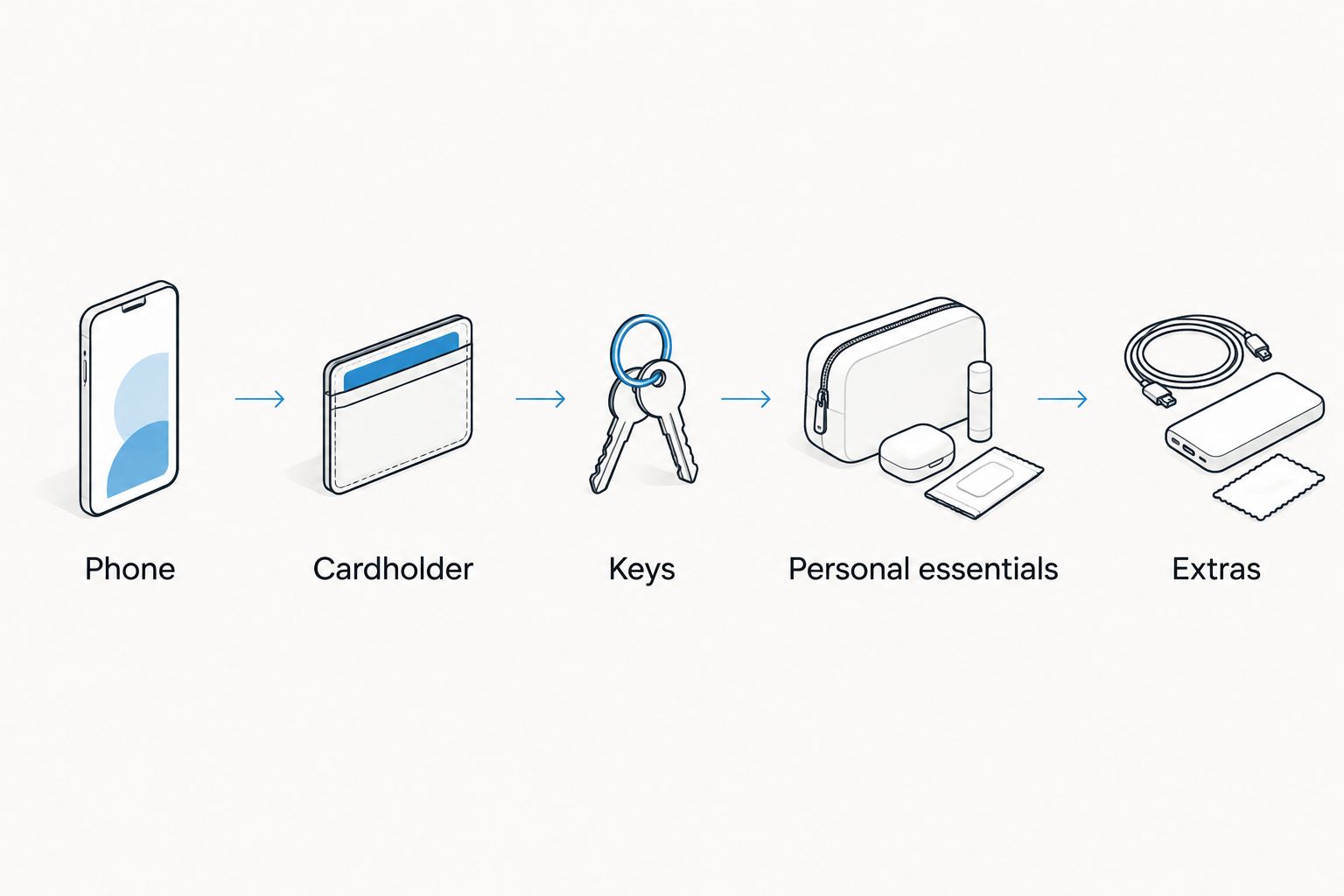
Follow this packing order
- Phone first. Put your cased phone through the opening without forcing it. Test the position you would use while carrying the bag.
- Cardholder next. Place it where you can remove it without lifting out everything else.
- Keys next. Keep teeth and metal attachments away from an unprotected phone screen.
- Personal essentials next. Add the items you cannot comfortably leave behind.
- Extras last. Add lipstick, earbuds, or another optional item only if the closure still works normally.
Finish by taking your phone out and putting it back. A bag that holds your belongings but makes them awkward to retrieve has passed only half the test.
Which mini shoulder bag shape suits your packing list?
Choose the shape around your largest rigid essential. For many packing lists, that means testing the phone first. If you need a glasses case or another firm container, test that alongside the phone rather than assuming it will fit afterward.
These are shape-based shopping options, not verified capacity ratings. Compare the actual interior and opening of each bag you consider in 2026.
| Shape | Best for | Useful feature to inspect | Trade-off to check |
|---|---|---|---|
| Long, shallow shape | A packing list organized around a phone | Uninterrupted horizontal space | Limited depth for stacking bulky items |
| Box-shaped mini | Separating compact essentials | Usable depth and a clear opening | Rigid corners restrict how objects sit |
| Soft, curved mini | Shoppers who prefer a less structured outline | How the opening behaves when loaded | Curves reduce usable space near the edges |
| Compartmented mini | Keeping cards and small items separated | Whether each section fits its intended item | Dividers split the available space |
Long, shallow mini: best for a phone-led checklist
Look for an interior that accepts your phone without forcing it diagonally against the closure. Then test the cardholder and keys beside it. A long outline is useful only when the opening lets you use that length.
The trade-off is depth. Do not assume a phone-friendly shape also accommodates a rigid sunglasses case or a full cosmetics pouch.
Box-shaped mini: best for organizing small essentials
Inspect how your belongings sit across the base. A clear, structured interior gives you a defined packing area, but every object still needs a workable position.
Test access as carefully as placement. If the phone blocks the cardholder, rearrange the load before deciding the bag works.
Soft, curved mini: best for a relaxed outfit silhouette
Check the bag while loaded rather than judging its empty shape. A curved corner is not the same as a rectangular storage space, and a soft opening can become harder to access under your arm.
Choose this outline because you like how it wears. Do not treat flexibility as permission to overfill it.
Why mini shoulder bag capacity varies
The word “mini” does not give you a usable packing measurement. Compare these details when reviewing a bag description or testing a bag you already own.
- Opening width: Your phone must pass through the entrance, not merely fit somewhere inside.
- Interior dimensions: Exterior measurements do not describe all the space available to your belongings.
- Base depth: Flat objects and bulky objects use the interior differently.
- Shape: Curved sides, tapered corners, and a narrow top affect placement.
- Compartments: Pockets help separate items, but each section has its own limits.
- Closure clearance: A zipper, flap, or clasp needs room to operate normally.
For your 2026 shopping checklist, record dimensions in the same unit throughout. Use inches if that is how the listing presents measurements; avoid comparing an inch measurement with a centimeter measurement without converting it.
Ask whether a listed dimension describes the exterior, interior, or opening when that distinction is unclear. A size label is not a phone-fit guarantee.
How do you check phone fit before buying?
Measure your phone with its everyday case attached. Include protruding grips or accessories rather than measuring the bare device and hoping the rest works.
Write down its height, width, and thickness. Compare those measurements with the bag information, then inspect the opening and closure separately. If the listing gives only exterior dimensions, do not treat those figures as confirmed usable interior space.
For a bag you already own, try the phone in the position you intend to carry it. Close the bag normally, lift it by its strap, and retrieve the phone again. That final movement reveals access problems that a static packing photo misses.
Can you use a paper template?
A paper outline helps you visualize length and width, but it does not reproduce thickness. Use it as a preliminary check, not proof of fit.
If you make a physical stand-in, match your cased phone’s dimensions as closely as possible. Never push a stiff template against a lining or closure to make the test succeed.
What should you leave out of a mini shoulder bag?
Start with duplicate items and bulky packaging—not the essentials you depend on. Replace a full wallet with a slim cardholder only if the smaller option holds everything you need for that outing.
Leave a full makeup pouch behind when a single touch-up item does the job. Skip decorative keychains when they make your key set difficult to place. Keep necessary keys together; do not simplify so aggressively that you leave behind something important.
A water bottle, tablet, full-size hairbrush, or large rigid case belongs on the test list if you genuinely need it. If those items fail the test, choose a larger bag instead of negotiating with a strained closure.
What about sunglasses and earbuds?
Test their protective cases, not just the objects inside. A pair of sunglasses that fits loose does not establish that its case will fit beside your phone.
Treat earbuds the same way. If the charging case forces you to remove a necessary item, the mini bag is not the right match for that particular outing.
How do you style mini shoulder bags with everyday outfits?
Keep the outfit bold and the packing simple. For Glamortrends fashion accessories shoppers, the useful question is not just whether a bag matches—it is whether the packed bag sits comfortably with the clothes you already wear.
Use these outfit formulas as your 2026 starting point. Each gives the bag a clear role without making the entire outfit compete for attention.
- Coffee or errands: Pair straight-leg jeans, a plain tee, and a cropped jacket with a mini shoulder bag. Test whether your essentials-only load is enough for the whole outing.
- Dinner: Wear a simple dress with a mini bag and one jewelry focal point. Keep the interior organized so you can reach your phone without unpacking at the table.
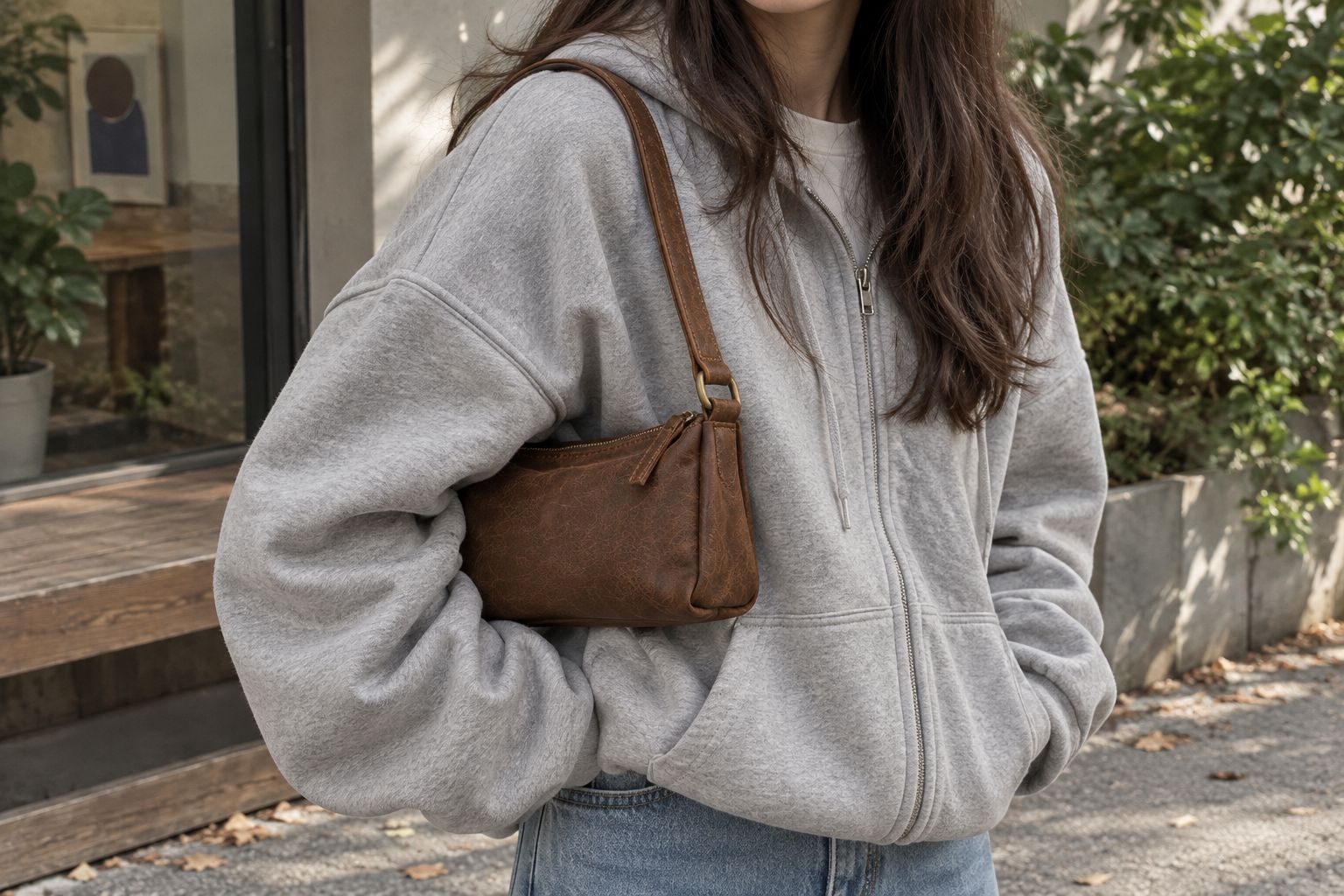
- Hoodie day: Combine an oversized zip-up hoodie, jeans, and a compact shoulder bag. Check the strap over the hoodie rather than assuming a bare-shoulder fit will translate.
- Jacket weather: Try the bag over your usual outer layer. Lift your arm, sit down, and check whether the bag stays where you want it.
A short strap changes how a bag sits against a sleeve. A roomy jacket or hoodie adds another layer to that relationship. Test the bag over the outfit you will actually wear.
For a dressier outfit, read the guide to mini shoulder bags for evenings out. Keep the same packing test even when the occasion changes.
What tells you a mini bag is overpacked?
Stop when the closure needs pressure, the outline visibly distorts, or taking out your phone requires removing several other items. Those are practical reasons to reduce the load or choose more room.
Do not judge success by whether the bag closes once on a table. Wear it with the planned contents and repeat your normal actions: reach for keys, remove your cardholder, and put your phone away.
Your final 2026 check is simple: the bag should close normally, carry comfortably for you, and let you reach the essentials. If the packing routine feels fussy at home, simplify it before leaving.
FAQ
What can I fit inside a mini shoulder bag?
Use your phone, a slim cardholder, keys, and a small personal essential as a test load. Actual capacity depends on the specific bag and the size of your belongings; this is not a guaranteed fit list.
Will my phone fit in a mini shoulder bag with its case on?
Confirm phone fit using measurements taken with the case attached. Check the opening and usable interior, then test whether the closure works without pressure.
Can I carry a full-size wallet in a mini shoulder bag?
A full-size wallet belongs in your fit test if you need to carry it. Compare its dimensions with the usable interior and test it alongside your phone rather than on its own.
Is a mini shoulder bag practical for everyday use?
A mini shoulder bag is practical when your required daily items fit and remain easy to reach. Choose a larger bag when you need items that fail the packing test.
Can I wear a mini shoulder bag over an oversized hoodie?
Test a mini shoulder bag over your actual hoodie before deciding the strap works. Check shoulder clearance, underarm space, and access while wearing the layers together.
Should I choose a structured or soft mini shoulder bag?
Choose between structured and soft mini shoulder bags by testing your essentials and preferred silhouette. Structured corners limit placement, while curved soft shapes still need a separate opening and closure check.
How do I stop my mini shoulder bag from looking overstuffed?
Pack required items first and remove optional extras if the closure needs pressure or the shape distorts. Choose more capacity when your necessary belongings do not fit comfortably.
One last thing
Test the bag when you are taking something out, not just putting everything in. A successful packing photo proves placement; an easy phone retrieval proves something more useful about everyday access.
Glamortrends outfit guidance starts with what you actually wear and carry. Put on your jacket, pack your essentials, and make that final access check before calling the bag a match.


