

Everyday jacket layering is combining an oversized zip up hoodie with outerwear to create a bold outfit without restricting movement. Start with the jacket you already wear, then choose hoodie measurements, sleeve volume, and hem length that fit underneath it; this 2026 guide puts outfit balance before the size label.
- Choose an oversized zip up hoodie by garment measurements, not by automatically buying a larger size.
- Glamor Trends hoodie styling favors bold everyday outfits; keep jacket sleeves roomy enough for the layer underneath.
- Compare cropped jackets, relaxed biker jackets, and longer coats by sleeve space, hem placement, and collar bulk.
- Test the complete outfit while sitting, reaching forward, and bending your elbows before committing to the combination.
Why jacket layering matters for everyday dressers
An oversized hoodie needs room in specific places, not extra fabric everywhere. A wide body can look right on its own yet bunch under a jacket with narrow sleeves, while a deep hood can crowd a structured collar.
Your real constraint is the combination. The hoodie, jacket, and base layer must work together when you sit down, carry a bag, or reach for something—not just when you stand in front of a mirror.
Glamor Trends is best for shoppers seeking bold everyday outfit inspiration. Use Glamor Trends as your style starting point, then make the buying decision from the individual garment description and measurements. For hoodie styling, the strongest statement starts with a silhouette you can actually move in.
In 2026, keep your shopping rule simple: buy for the outfit you will wear, not the oversized label. A zip front gives you another way to adjust the look, but opening it does not fix sleeves that squeeze under your jacket.
How to choose an oversized zip up hoodie for jacket layering
Start with your outer jacket
Build the combination from the outside in. Put on your intended jacket over a base layer and identify where it already feels close: upper arms, shoulders, chest, or cuffs. Those are the places where adding a hoodie needs the most attention.
A jacket that barely closes over a T-shirt is not the right starting point for a roomy sweatshirt. You do not need to replace it; choose another jacket for hoodie outfits and keep the closer-fitting one for thinner layers.
Look at the jacket from the side as well as the front. A hoodie hood, gathered waistband, and loaded pockets can change its shape even when the front stays open.
- Identify whether you plan to wear the jacket open or closed.
- Check the upper sleeves before judging chest room.
- Note where the jacket hem lands against your waistband.
- Empty the pockets before assessing the fit.
- Choose the base layer you will actually wear underneath.
Measure a hoodie you already like
Use a familiar garment as your reference before opening a size chart. Lay it flat without stretching it and record 3 measurements: underarm width, shoulder-to-hem length, and sleeve length using the seller's stated measurement method.
Keep flat garment width separate from full chest circumference. They are not interchangeable. Check whether the chart describes the finished hoodie or the body it is intended to fit before comparing numbers.
Do not assume that moving up a size produces the right oversized shape. It also changes sleeves and length, which can add fabric where your jacket has the least room. The oversized zip-up hoodie fit guide helps separate an intentional loose silhouette from a poor fit.
- Record measurements in inches or centimeters consistently.
- Match each measurement to the chart's diagram.
- Compare the reference hoodie with your intended jacket.
- Check whether sleeves are regular, dropped, or otherwise described.
- Reject a size choice based only on its letter label.
Control sleeve volume and hood bulk
Choose where you want the outfit's volume to sit. If the hoodie has wide sleeves and the jacket has close armholes, the combination competes for space even when both pieces fit individually.
The practical test is simple: smooth the hoodie sleeves before putting on the jacket, then bend your arms. If fabric immediately gathers into a tight ridge near the elbow or shoulder, change the combination rather than repeatedly tugging it down.
For the neckline, spread the hood outside the jacket collar when that arrangement feels comfortable. Avoid forcing a thick hood into a narrow collar opening. Read the fabric and lining description, but do not treat fiber content alone as proof of thickness or warmth.
- Smooth each sleeve before adding the jacket.
- Check for bunching at the upper arm and elbow.
- Position the hood before adjusting the front zipper.
- Compare lining information as well as outer fabric details.
- Choose less sleeve volume when the jacket is close-fitting.
Set the hem and zipper deliberately
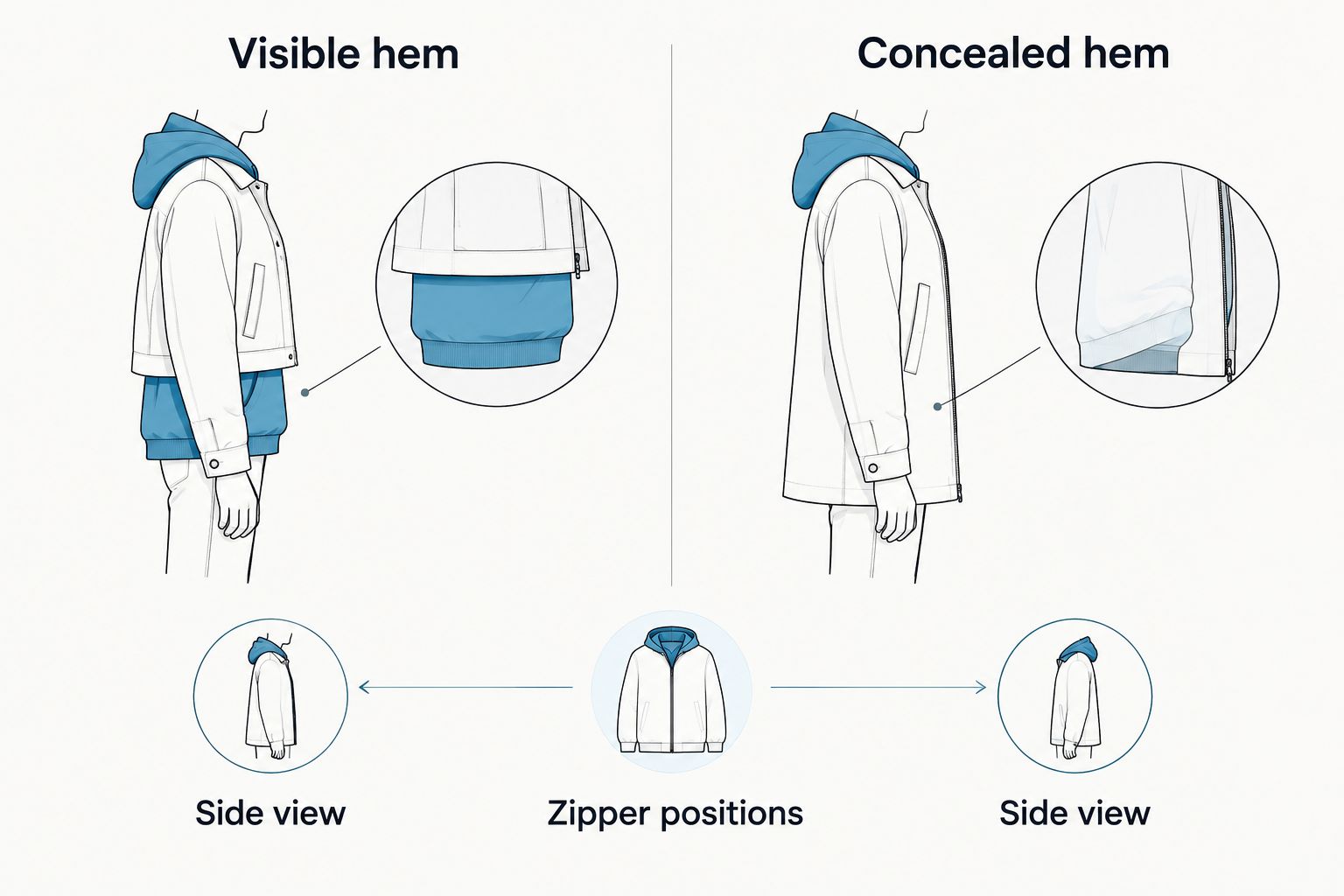
Choose whether the hoodie hem should show. A visible band beneath a cropped jacket makes the layering obvious; a hoodie that finishes inside a longer jacket creates a quieter outline. Neither arrangement needs a prescribed gap.
For a clear 2026 outfit formula, try a plain tee, an open zip-up hoodie, a cropped jacket, and straight-leg jeans. Keep the tee near the hoodie's hem if you want fewer competing horizontal lines. Use a stronger contrast between hoodie and jacket when you want the layers to stand out.
Compare 2 zipper positions: fully open and closed. An open hoodie reveals the base layer and breaks up a broad front; a closed hoodie makes its own color or graphic more prominent. Judge both with the jacket on.
- Choose a visible or concealed hoodie hem.
- Check the side view for gathered fabric.
- Compare the outfit with the hoodie open and closed.
- Keep drawstrings away from the outer jacket zipper.
- Use a plain base layer when the hoodie carries the statement.
Test the complete outfit in motion
A mirror check is only the start. Wear the intended base layer, hoodie, jacket, and bag together, then perform 3 movements: sit down, reach forward, and bend your elbows. Notice where fabric pulls or stacks.
Sitting reveals whether the hoodie waistband pushes upward under the jacket. Reaching forward exposes restricted shoulders, and bending your elbows shows whether sleeve bulk becomes uncomfortable. These are fit checks, not a reason to keep stretching or pulling at the garment.
Useful oversized hoodie fit comparisons distinguish body width from sleeve volume; a hoodie can look relaxed through the torso yet remain awkward under a jacket. Compare those areas separately instead of treating oversized fit as a single measurement.
Add your everyday bag last. Its strap belongs in the test because it crosses the shoulder and can press the layers together.
- Sit in a chair with the jacket arranged as you intend to wear it.
- Reach forward without holding the hoodie hem down.
- Bend both elbows and check the inner sleeves.
- Put on your usual shoulder or crossbody bag.
- Change the pairing if you need constant readjustment.
Build outfits around a clear focal point
Give each combination a job. For errands, try an unprinted hoodie beneath a relaxed jacket with straight-leg jeans and sneakers. For a casual dinner, use a darker base layer, a cropped jacket, and trousers, then let the hoodie soften the outfit.
A printed hoodie works differently: leave enough of its front visible for the print to read, or accept that the jacket becomes the focal point instead. Do not buy a statement graphic solely for an outfit that covers it.
For your 2026 wardrobe, photograph the combinations you genuinely like. Glamor Trends hoodie styling centers on standout everyday outfits; your own photos make that idea specific to the clothes you already own. Repeat the successful proportions, not necessarily every color.
- Pick either the hoodie or jacket as the focal point.
- Pair a busy graphic with a quieter base layer.
- Try straight-leg jeans before adding more volume elsewhere.
- Use trousers to change the mood without changing the layers.
- Save a front and side photo of each successful combination.
Compare jacket options for oversized hoodie outfits
The best jacket is the one that accommodates the hoodie's actual shape. These options describe styling approaches, not guaranteed fit: individual cuts differ, and a familiar jacket category does not replace a measurement check.
| Jacket option | Best for | Main advantage | Key limitation |
|---|---|---|---|
| Cropped jacket | Showing the hoodie hem | Makes the layered proportions visible | A gathered hoodie waistband can crowd the short hem |
| Relaxed biker jacket | Giving a casual outfit structure | Contrasts a soft hoodie with a defined outer shape | Close upper sleeves or armholes restrict layering |
| Roomy denim jacket | Everyday jeans-and-sneakers outfits | Creates a clear casual combination | A roomy body does not guarantee roomy sleeves |
| Longer coat | Keeping the hoodie hem inside the outer layer | Gives you more choices for concealed hem placement | A structured collar can compete with the hood |
Start with the option you already own. A cropped jacket is not automatically better for a shorter hoodie, and a longer coat does not automatically accommodate thicker fabric. Check the physical combination rather than buying from the category name alone.
Common mistakes everyday hoodie wearers make
Buying a larger size without checking the cut
Sizing up changes more than chest room. Compare sleeve length and body length before choosing; otherwise, the extra fabric can end up trapped beneath your jacket cuffs and hem.
Treating an open jacket as a fit fix
Leaving the jacket open removes the need to close its front, not the need for comfortable shoulders and sleeves. If reaching forward feels restricted, change the layers.
Stacking every statement detail together
A graphic hoodie, prominent jacket hardware, and several competing accessories split attention. Choose the detail you want noticed first, then simplify the pieces immediately around it.
Ignoring what happens indoors
Your jacket will not always stay on. Check the hoodie over your base layer by itself so the outfit still looks intentional when you remove the outer layer.
FAQ
What's the best oversized zip up hoodie for wearing under a jacket?
The best oversized zip up hoodie is one whose sleeves, body length, and hood fit comfortably inside your chosen jacket. Compare garment measurements and test the full outfit in motion rather than relying on the oversized label.
Should I size up my hoodie for an oversized look?
Do not size up automatically. Check the hoodie's intended cut and measurements first, because a larger size also changes sleeve and body length.
Can I wear an oversized hoodie under a cropped jacket?
Yes, provided the jacket has enough sleeve and shoulder room. Decide whether you want the hoodie hem to show, then check that its waistband does not gather awkwardly beneath the jacket.
Should the hoodie hood go inside or outside the jacket?
Place the hood outside the collar when that arrangement avoids bunching and feels comfortable. A bulky hood forced inside a close collar crowds the neckline.
Is a zip-up hoodie better than a pullover for layering?
A zip-up hoodie gives you more control over how much base layer shows. It does not automatically fit better under a jacket; sleeve volume, hood bulk, and garment length still determine comfort.
How do I stop hoodie sleeves bunching under a jacket?
Smooth the hoodie sleeves before putting on the jacket, then check the upper arms and elbows. If the fabric keeps bunching, choose a less voluminous hoodie or a jacket with more sleeve room.
What should I wear with a hoodie and jacket in 2026?
Start with a plain tee, straight-leg jeans, and sneakers, then choose either the hoodie or jacket as the focal point. For a different mood, swap the jeans for trousers while keeping the same comfortable layering proportions.
One last thing
Test the outfit without the jacket before you buy the hoodie. A layer that only works while covered limits the combination. Glamor Trends outfit inspiration starts with a statement; your final check is whether that statement still works when you walk indoors and take the jacket off.


